












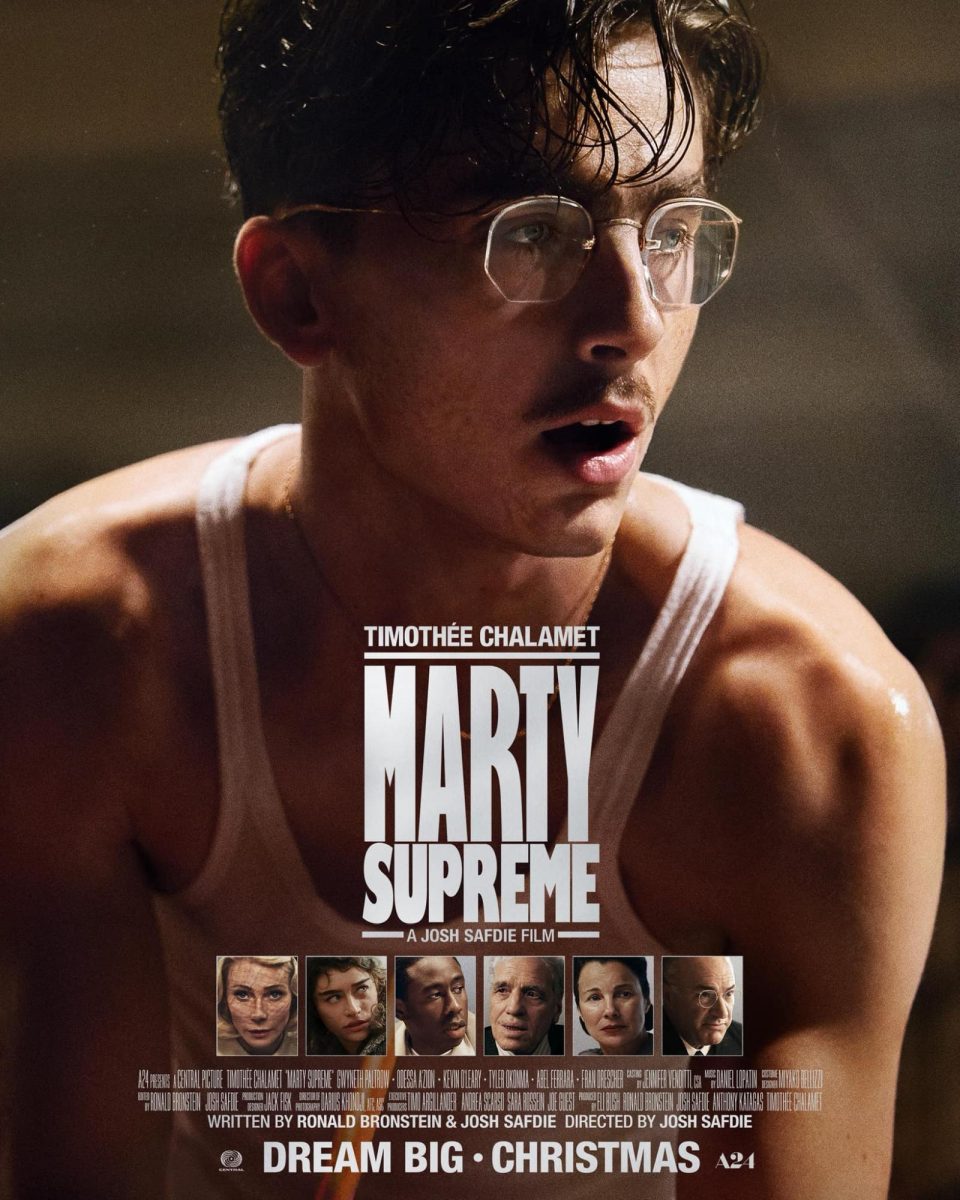
Timothée Chalamet is on his hands and knees for an Oscar—and “Marty Supreme” might be the key to receiving it.
Obviously, I couldn’t ignore the constant buzz of “Marty Supreme Christmas Day” all over my social media feeds—the cool Marty Supreme-styled windbreakers which had wound up in the hands of various celebrities (and yes, I would like one too) and Chalamet’s 20-minute marketing stunt “Zoom call.” I knew I had to see this movie, and it delivered on its premise. It surpassed its $70 million budget at the box office, making it one of A24’s highest grossing films, as well as a fan favorite.
This compelling, dream-centered drama, directed by Josh Safdie, never failed to lose my attention—which is no small feat. Set in 1950s New York, the story follows young Marty Mauser, determined to follow his dreams to be the face of ping pong in America. Marty is a rather obnoxious, egocentric, and ambitious character, who wants nothing more than to become a pingpong star—and will do anything to make it. He screws people over, lies, and manipulates in order to reach his goals. Loosely tied to the real story of ping pong fanatic Marty Reisman, Chalamet was fittingly chosen for this role, who previously said that he was “in the pursuit of greatness” during his 2025 SAG awards acceptance speech. Determined to be one of the greats, Chalamet and Marty share common ground, leading to a more dedicated performance.
The story itself can be overlooked at first: it’s about a self-centered guy who wants to be a ping pong star. Great. But I promise, there is a bigger picture. Marty doesn’t just represent a gritty, ambitious guy, but he represents the American Dream. Marty is an individual in the pursuit of greatness, who shows how hard work can lead one to success, encouraging him to accept the challenges he is faced with in order to achieve greatness.
Marty’s life is also remarkably entertaining, leading you to questioning what he will wind up doing next. Between robbery, fleeing from the police, and flying around the world, the life of Marty Mauser is undeniably unpredictable; like a ping pong ball, he bounces back and forth between winning and losing. Marty deals with tons of losses, but despite this, he maintains a resilient attitude, continuing to work toward his dreams.
Throughout this journey, he still (sometimes) ends up being there for the people he loves. Characters like Marty’s close friend Willy, played by Tyler (The Creator) Okonma, and Rachel (Odessa A’zion) always have Marty’s back, helping him carry out various schemes in order to maintain money. Okonma was phenomenal in his first movie role, and definitely deserved more screentime. A’zion was excellent in her role, playing Marty’s childhood friend who gets swept up into his chaotic life as he is in the pursuit of becoming a ping pong star. Marty also wins over Kay Stone, a wealthy famous actress, played by Gwyneth Paltrow. Her character shows to Marty’s persona—as he does have some intimate scenes with married women, Kay and Rachel.
Safdie, the director, was absolutely brilliant. His unique style is entertaining for those who love action and drama. His filmography is full of high-stake movies, like “Uncut Gems” and “Good Time.” Safdie’s films always include a sense of urgency. The camera work is up close and fast paced, chasing after Marty while he’s running from the police. If you get dizzy easily, you may not enjoy some of the ping pong scenes, where the camera goes back and forth. However, it’s highly engaging. It feels as if you’re in the audience, following the ball with your eyes.
Safdie likes to cast real-life figures as versions of themselves, which is exactly what he did with Kevin O’Leary, who played a rich and ruthless business man. His role: Milton Rockwell—married to Kay Stone— made bargains with Marty, supplying him money with the demand of compliance in return. This choice is unique but compelling. As an audience member, it felt like Mr. Rockwell was actually O’Leary, which both threw me off and made me realize that by O’Leary essentially playing himself. There are Martys and Mr. Rockwells in our world too.
Instead of taping up movie posters, the Marty Supreme marketing team took movie promotion to another level. The marketing campaigns made subtle references to things in the movie: Marty on the Wheaties box, the orange ping pong balls, etc. It made Marty seem like a real life ping pong star rather than just a movie character. The best part? Chalamet was very into the marketing campaign, adding his own little twists and ultimately composing up to the fans’ excitement. I wonder how future films will take it to the next level considering the amazing impact the Marty Supreme marketing had on the movie’s success, turning Marty Mauser into the face of our America.
In the end, I found myself rooting for Marty. Although he is a terrible person, I was charmed by his determination and grit. He represents the desire to be a winner, inspiring us to reach our goals (without being a jerk, obviously). His story can resonate deep within us, because we all have dreams and desires that we wish to achieve—Marty was determined to do so. Chalamet rightfully deserves his Oscar after this film—he and Marty both prove that while chasing your dreams hard work is inevitable, but ultimately, greatness is reachable.