




Pig costumes, orange wigs, and thousands upon thousands of Chicagoans marching toward something greater: democracy.
On Saturday, Oct. 18, Chicago joined the second nationwide day of No Kings protests across the United States. Protestors waved American flags and handmade posters through the air, rallied together by their core belief that power should be in the hands of the people. Through chants, “What do we want? Democracy! When do we want it? Now!” and a unified march toward the Trump Tower, Chicago protestors spoke out against federal overreach under the current Trump administration.
New Trier High School’s Trevians were no exception. Among the over 7 million protestors participating across the country, New Trier students, too, took matters into their own hands.
“History doesn’t lay a big award to bystanders,” senior David Gorelick, who marched on Oct. 18 at Grant Park, says. “When it comes to very pressing times and inflection points of history…you have to make your stand.”
The Illinois protestors primarily contested the escalation of ICE raids across the Chicagoland area. After Operation Midway Blitz was declared on Sept. 9, thousands of immigrants have been detained, often shown being handled aggressively by ICE agents before being shoved into the back of a dark SUV.
“There’s such a combined sense of grief and anger in the nation,” senior Sai Isha Swaminathan, who marched at both the June 14 Daley Plaza protest and Oct. 18 Grant Park protest, says. “The issues are so widespread and it’s hard to find someone who’s not been affected.”
Amidst the anger, fear, and frustration, Oct. 18 brought many a sense of hope.
“Once we got onto the road and we started marching and chanting, it was really awesome,” Swaminathan says. “There was a sea of people, and we were all chanting the same thing. It was a very humbling thing to see all of these people show up for the same cause.”
Protestors gathered to march at over 30 Illinois locations, fostering participation and accessibility as more joined the fight for liberty.
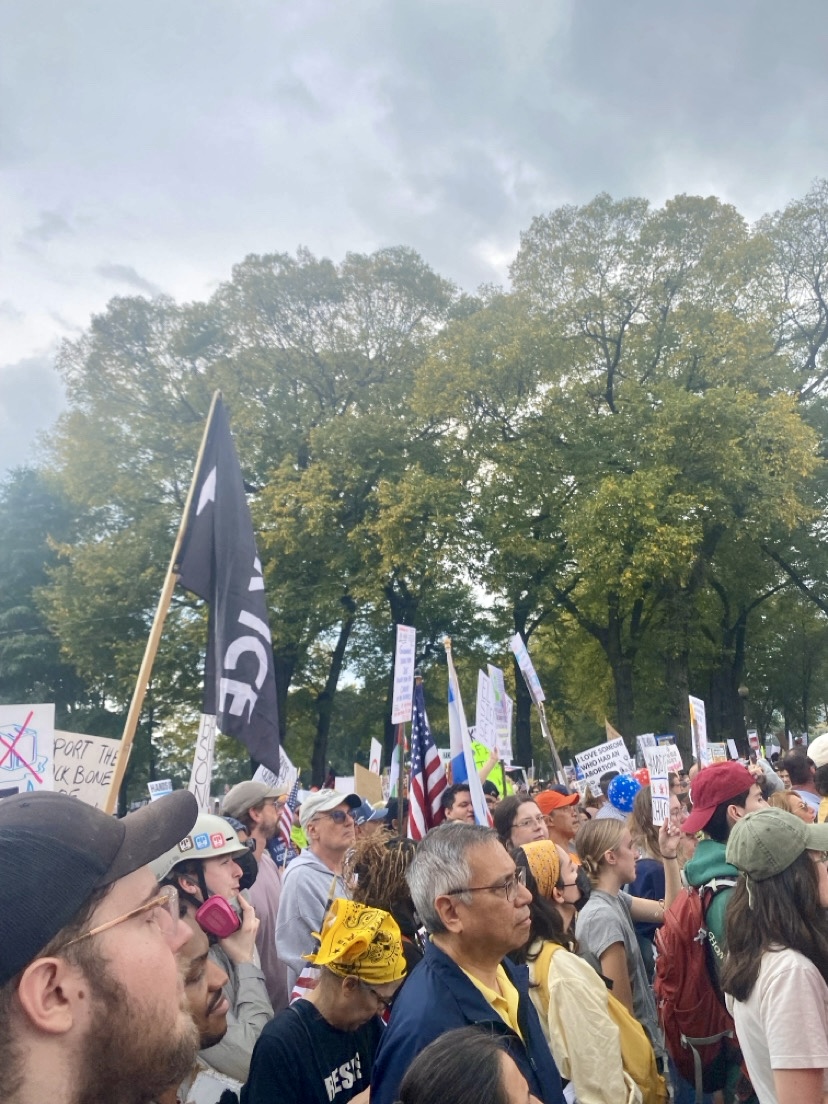
“There was a sense of mutual understanding,” senior Ananya Ray, who attended the Wilmette protest outside of Village Hall, says. “A calm understanding…[and] a sense of, you know what’s going on, I know what’s going on. The idea of being there together already means you’re on the same page.”
The collective nature of the protests contributed to the day’s unified and bold spirit. Protestors dressed up in costume, waved banners, and shouted slogans as their hard work came together.
“I saw a costume of a guy with a pig outfit, a suit, and a yellow toupee on,” Gorelick says. “It was kind of like watching Trump being a pig, and he was holding a sign [that read] ‘Release the files.’ It was very comedic and, unfortunately, very true.”
The protestors’ posters allowed participants to share their opinions and beliefs with others.
“My most recent one [poster] was, ‘Stop pretending racism is patriotism,’ and I wrote “F— ICE on bottom,” Swaminathan says. “Being able to change or being able to have your voice heard starts a lot earlier than voting. Even just going with your parents to vote or going to the marches, that’s such a good way to start establishing your mark on your country.”
While Swaminathan, Ray, and Gorelick are all under 18 years old and unable to vote, they believe democracy extends beyond age. They stress the importance of getting involved as early as possible, setting the precedent for future generations of civil activists.
“These years are very important in forming opinions about what we value as a country and as members of this democratic society,” Gorelick says. “The earlier you start becoming educated and informed, the sooner you can make the right decisions.”
The North Shore is often considered a relatively isolated, insular community, stereotyped by its wealthy residents and opulent homes, yet policy implemented under the current administration affects everyone. ICE has taken an especially prominent presence in the Evanston and Wilmette communities, with landscaping workers undergoing recent arrests while at work. The recent protests gave way for locals to get involved with something bigger, popping what’s often referred to as the “North Shore bubble.”
“I think there’s this idea of the ‘North Shore bubble’ where issues that are affecting the United States or the world don’t affect us here, which I think is true a lot of the time,” Ray says. “But instead of using the ‘North Shore bubble’ to not do anything, we should use it to step in and help speak up for communities that are more marginalized and don’t have this opportunity to speak up.”
For Ray, who is looking to major in political science, the day validated her desire to contribute on a grander scale. The large crowds and strong sense of community confirmed her belief that citizens have the power to make real change.
“I feel like at school before, I’d always been told that politics didn’t affect me, and it kind of made me feel like there wasn’t a reason that I cared so deeply,” Ray says. “I knew that if I went to the protest, I’d be validated. Seeing so many friends, parents and neighbors made me realize that there [are] people that believe the same things as me.”
Ray is taking her action further, building off of a past internship at Go Green Wilmette, combined with relationships formed at the protest, to amplify her political voice.
“Protests are one of the first ways that students can get involved…and it inspired me to reach out to village Board Representatives who are working in local government,” Ray adds. “I’m going to try to work on some of their campaigns.”
For all three young activists, the No Kings protest was just the beginning of a commitment to justice, action, and leaving the world just a little better than before.
“There are real people out there that are facing very direct consequences to the actions of the people in Washington,” Gorelick says. “I owe it to myself and I owe it to other people to take a stand and start being more active.”
Susan McNeil Hamilton class of 1968
Nov 14, 2025 at 4:18 pm
This is inappropriate for a public school ”newsletter” as it is clearly politically biased.