







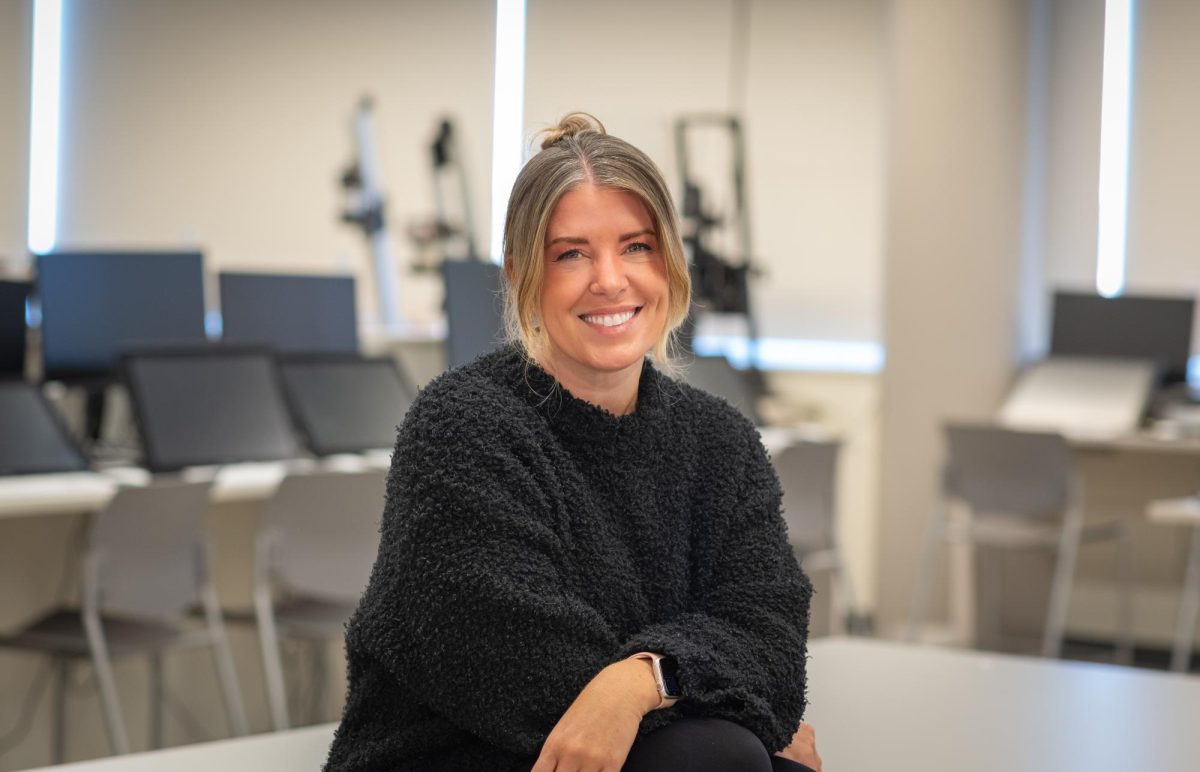
As artificial intelligence (AI) use in classrooms has increased at an exponential rate in recent years, instead of restricting its use in student work or turning a blind eye, New Trier High School art teacher Jennifer Jackson has embraced its growing role in the creative field. What began as curiosity about how AI worked grew into a passion that drove Jackson to complete an AI certification program and attend a conference to learn more about AI capabilities in Adobe programming, all in part to help her accomplish her goal of promoting AI literacy.
“I was finding that I was being talked to about AI, and I hate that. I like to be a part of the conversation,” Jackson says. “So I wanted to pop the hood, so to speak, and learn how the models actually work.”
In her Graphics and Design and Darkroom Photography classes, students interact with AI when using Adobe Firefly, which can be accessed within Adobe Photoshop and Illustrator to generate images, sound effects, video clips, and more. Within Firefly, users can use multiple models, including those from OpenAI and Google, to create their content. From using what Jackson refers to as the “healing tool” to remove flaws from images, to using the model to help ideate what a project could look like, students are learning how to interact with the programming,using it as a tool instead of having it complete work as their own.
“It’s a way for me to dream quicker on what the final result could be so I can get to actually creating it,” Jackson says. “So for creative industries, I see it more of like ideation steps, but not the final thing.”
Jackson is teaching her students how to use Firefly to push their work further and expand their creativity. In Firefly, they are able to generate ideas through written prompts, but also upload images of work and have it change the medium the image appears to be in or the color palette. By interacting with the software more, students are also becoming better at distinguishing what is human-made and what is the work of generative AI.
“What’s interesting is whenever they get their results…they’re like, ‘oh, that looks so fake. This looks so generated,’” Jackson says. “Just by using it, I feel like they’re starting to notice what makes it look like it’s not real. But, I’m also teaching them how to take something like that and use the basic tools in the programs to conceal the fact that it is AI.”
In order to become more knowledgeable around the software and AI advancements, Jackson completed a 20-week online certification program through the New School at Parsons, where she completed discussions, read books, and interacted with classmates to learn how the models work and perform.
“I really know how this works now,” Jackson says. “Now I’m like, ‘I’m teaching this [AI] to you so that you can make an informed decision. You’re not always going to need it.’…It made me more aware of the tools that I was already using.”
In addition to becoming AI certified, Jackson attended the Adobe MAX Conference on Oct. 28-30 in Los Angeles, which brought together thousands of industry professionals to listen to speakers, attend workshops, and learn more about Adobe programming. This year, the focus of the conference was generative AI.
“Being able to move around and actually have conversations, I was able to see how creative industries are begging for more and more art-minded people,” Jackson says. “And so it was really refreshing to see that AI is not replacing us. It’s actually needing more humans to help create in corporate industries and creative industries and just even stand alone, if you want to be an artist.”
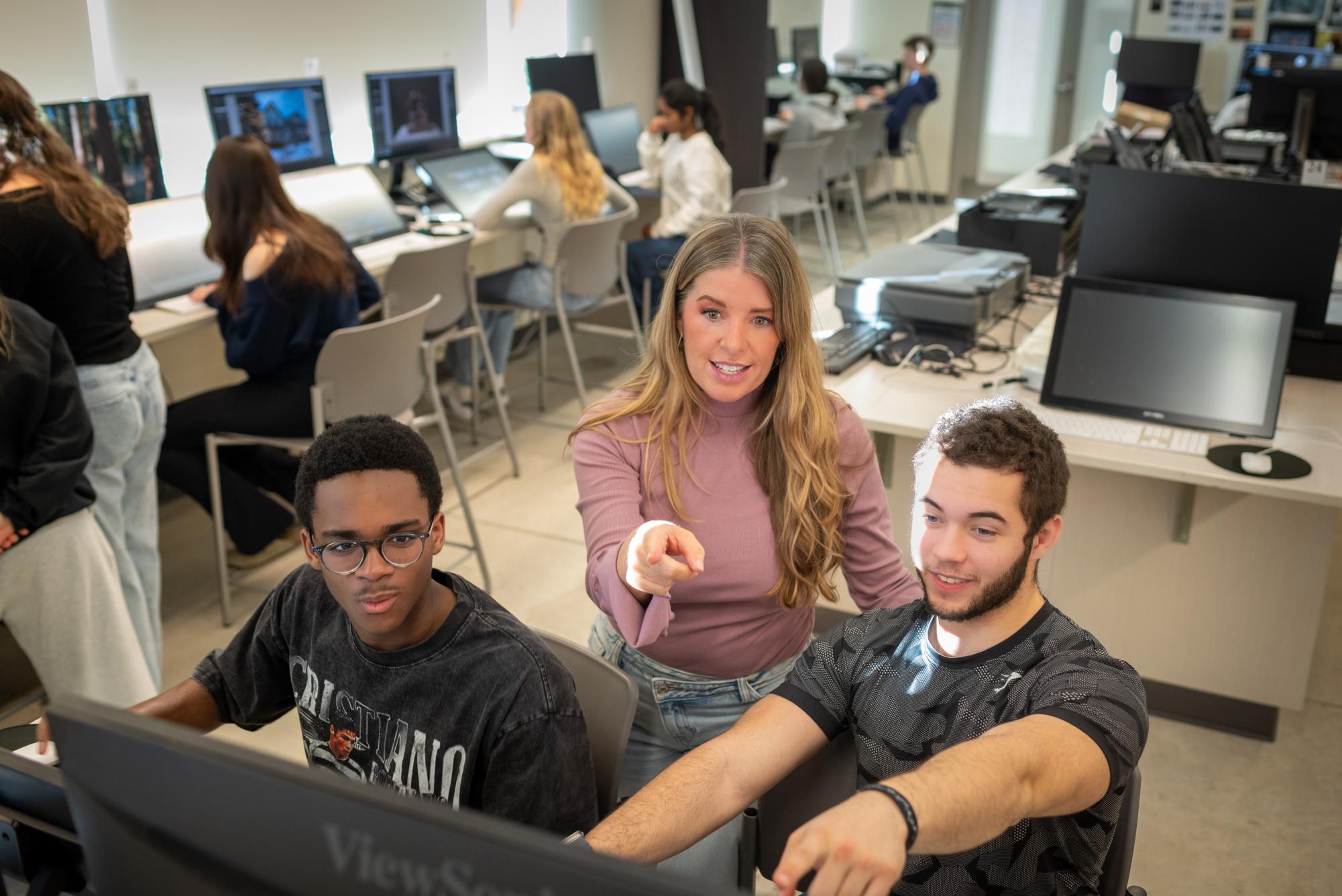
Equipped with more knowledge and a better understanding of how AI will impact students as they enter the workforce, Jackson believes that having conversations in education about how to work with and recognize AI is becoming even more important, especially as technology advances.
“I feel like we’re missing an opportunity in the school to teach our students more about when it is appropriate and when it’s not, instead of just saying you can’t use it altogether,” Jackson says. “I’d like to open up the conversation more so that [students are] aware of what these tools do, aware of what the implications are as far as protecting the integrity of your own work, but also when is it appropriate and when isn’t it appropriate to use it and making better decisions.”
In addition to the ethics of using AI in the first place, Jackson has also considered the safety of her students and their work as they learn how to use these models and implement them in their own art.
“[Students are] using their database and then also generative AI, which is in Adobe, a protected database where anybody who puts their images in it has given permission to use the images,” Jackson says. “So it’s not sampling from students’ artwork to train the model, which is why it’s safe to use in an educational setting.”
While AI has helped artists take their work a step further, Jackson acknowledges that there are ways in which creatives and their work still need to be protected.
“Lawmakers are trying to play catch up in what the laws look like to protect people in the creative industries, but also our students and intellectual property,” Jackson says. “We’re kind of putting the cart before the horse right now, and it’s moving so fast. I wanted to jump in and start going along for the ride.”
Jackson believes that the value of AI in creative industries should be to develop your vision for a piece faster, not to have it do your work for you, as many students are using other AI models to do.
“I don’t think AI should be in writing. I think ChatGPT writing essays is completely different, and I’m against that,” Jackson says. “But where it can be handy is for writing generative prompts to help get the results you need creatively.”
Although Jackson sees the way AI has been used for good in her field, she emphasizes that she does not think AI should be used throughout schooling entirely. She shares that while she was at the Adobe MAX Conference, she had students write about their emotional responses to photographs, and many students used generative AI to complete the work.
“The thing that’s really difficult is, I explicitly said [no AI],” Jackson says. “I asked you to just come up with something from scratch based on what you felt like from seeing this video documentary or looking at this photo and you couldn’t do it. And that’s where I feel like there’s a little bit of sadness. [I asked to] tap into the emotional side of that response to that artwork and they couldn’t do it.”
Jackson hopes that the experience students have with industry standard equipment like XP Pen Drawing Tablets, coupled with her lessons in AI literacy and how to use AI as a tool, will help set them up for success as they enter university and creative careers.
“I want to make sure that by learning about AI literacy in creative industries and software, they weren’t learning it for the first time in college,” Jackson says. “I want them to go in with that knowledge because it’s moving so fast. I want them to be ready.”