




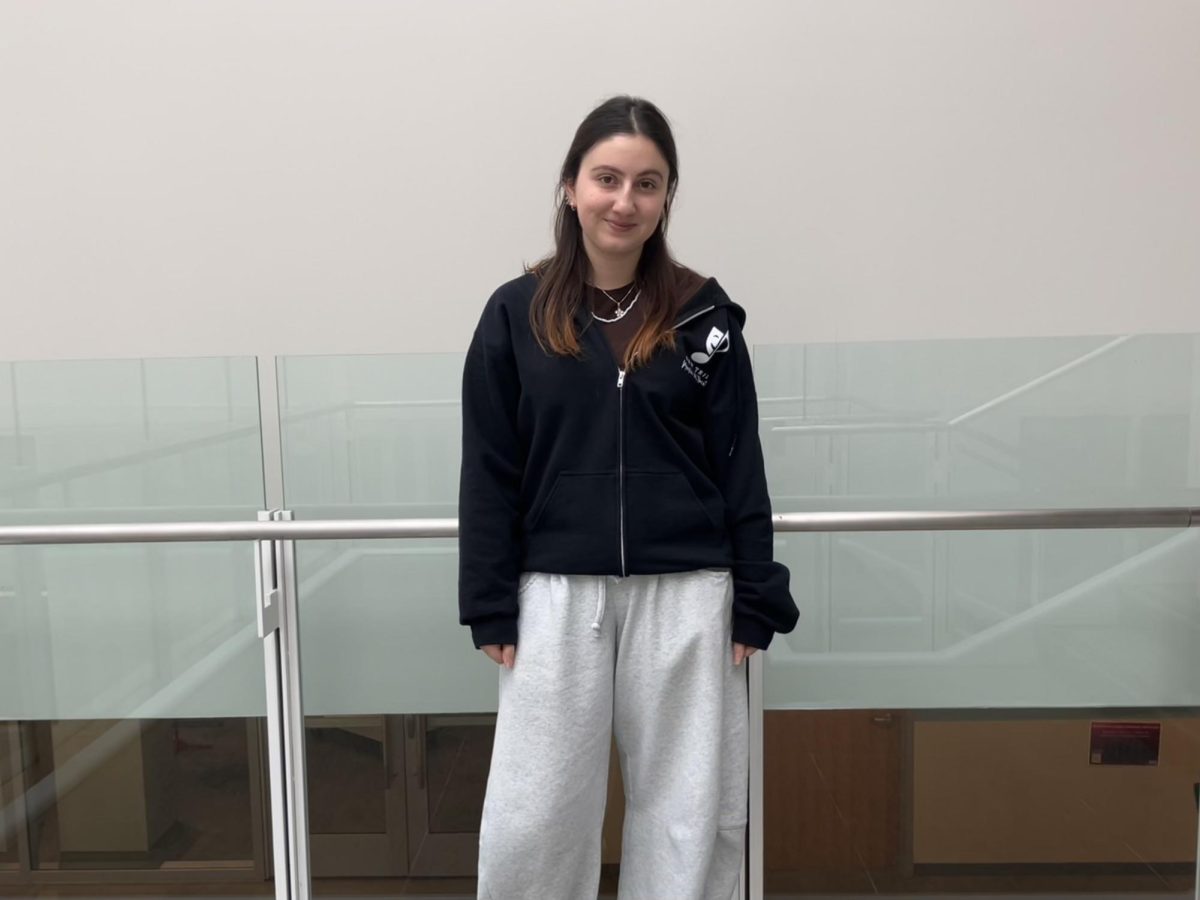
When Lori Manukyan first arrived in the U.S. in August, she stepped into a new chapter of self-discovery. Having already graduated the equivalent of American high school in Armenia, she chose to spend a year abroad in order to gain new experiences and figure out what she wanted for her future.
“I kind of didn’t know what to do,” she says. “I needed some more time to get to know myself better, and I think it’s happening.”
Manukyan’s journey to New Trier began with a highly selective scholarship funded by the U.S. government. The application process involved three rounds, including submitting multiple essays, undergoing English testing, and attending in-person interviews.
“I just applied, because the acceptance rate is very low, like 2% or something,” Manukyan says. “I got in and somehow, I’m here.”
She met her host family, the Moses-Rosenthals, for the first time on Aug. 7, which also happened to be her 18th birthday. After nearly two days of travel, she was exhausted, but it quickly became memorable for a different reason: she and her host mom looked shockingly alike.
“Someone actually asked [my host mom], is she your daughter or something?” Manukyan explains. “It’s actually great. I love [my host family].”
Since that moment, the relationship between them has grown into a steady source of comfort. A typical day together might include breakfast, a family activity, an outing, and sometimes an evening movie or pizza.
“We don’t choose where we stay—the host families choose us. Honestly, I didn’t care where I would be staying, because the most important thing is who your host family is,” Manukyan says.
At New Trier, Manukyan found a sense of academic freedom that contrasted with her previous schooling in Armenia. Back home, students follow rigid schedules filled with required subjects: four sciences, three languages, world history, Armenian history, and Armenian Church history.
“[In Armenia], you don’t get to pick your classes. You have to learn like 12 subjects,” she says. “You cannot have fun. I think we’re more of a traditional country, with the school system.”
At New Trier, the ability to choose courses felt refreshing for Manukyan. Having sung in her mother’s choir in Armenia, choir quickly became one of her favorite classes, and she looks forward to it almost every day. New Trier has given her the opportunity to expand her interest in music. Besides singing, she enjoys listening to rock as well as classical music.
“My favorite artist, his name is Serj Tankian. He’s the singer from System of a Down. He is Armenian, but he lives in the U.S.,” she says.
Beyond academics and classes, Manukyan joined the JV girl’s bowling team, an after-school sport that would not have been an option in Armenia. Her teammates and coach made the season a great experience for her, helping her feel more involved in the community.
“The season is almost over, and [Feb. 2] is our senior night. I had so much fun doing it,” she says. “I love Ms. Gnant, she’s my forensics teacher, and also my bowling teacher.”
The feeling is mutual for Gnant, who is impressed by Manukyan as a student as well a teammate.
“It’s incredibly brave to study abroad for a year in a place where you don’t speak your native language,” Gnant says. “Lori has a great attitude and is always willing to try, even when she’s overwhelmed. She made amazing progress over the [bowling] season, and I love her enthusiasm for trying new things and just enjoying the ride.”
Socially, the transition has not always been easy. Manukyan notes that it can be difficult to form close friendships at New Trier because many students have known each other for years.
“Sometimes it’s easier to talk to other exchange students, because we understand each other better. Some people talk to you, but you never become close friends,” she explains.
Isabell Schleiger, another New Trier exchange student from Germany, describes her impression and continued friendship with Manukyan—an exception to the otherwise intimidating social environment.
”Lori is a very kind and caring person,” Schleiger says. “Talking to her is not having just a simple conversation—she makes you think deeper and question your own perspective on life.”
Manukyan’s ties to Armenia remain strong. She speaks with her family back home several times a week, and occasionally gets homesick.
“I miss my family a lot, my friends, and Armenian food,” she says. “[In Armenia], we have a dish that is meat inside of grape leaves, called dolma. And khorovats, it’s kind of like barbecue, but it’s better. You can actually taste the fire.”
In her free time, Manukyan enjoys working out and reading, often gravitating toward historical literature. At New Trier, she is currently learning about the Vietnam war, which she finds fascinating.
“At school [in Armenia] we needed to read an 800-page book. It was about the history of Vardan and the Armenian Rebellion, and I really enjoyed it,” she says. “It was so interesting, I think it could be a show.”
Manukyan remembers her time spent abroad with small, physical mementos such as bracelets and necklaces. In the past, she’s traveled to countries such as France, Norway, Georgia, and Russia.
“I have this thing when I go to another city or country, I buy something to remember it,” she says. “I have a lot of jewelry that reminds me of [these places].”
As the year goes on, Manukyan finds herself reflecting on the opportunity she was given and the expectations she had before arriving in America.
“I was so excited when I learned I was coming to Chicago, because it’s kind of like a cultural center of the U.S.,” she says. “People think of America as a big dream, like the American dream, and it’s so cool to live here, especially to have an exchange year here—I’m so grateful for it.”