








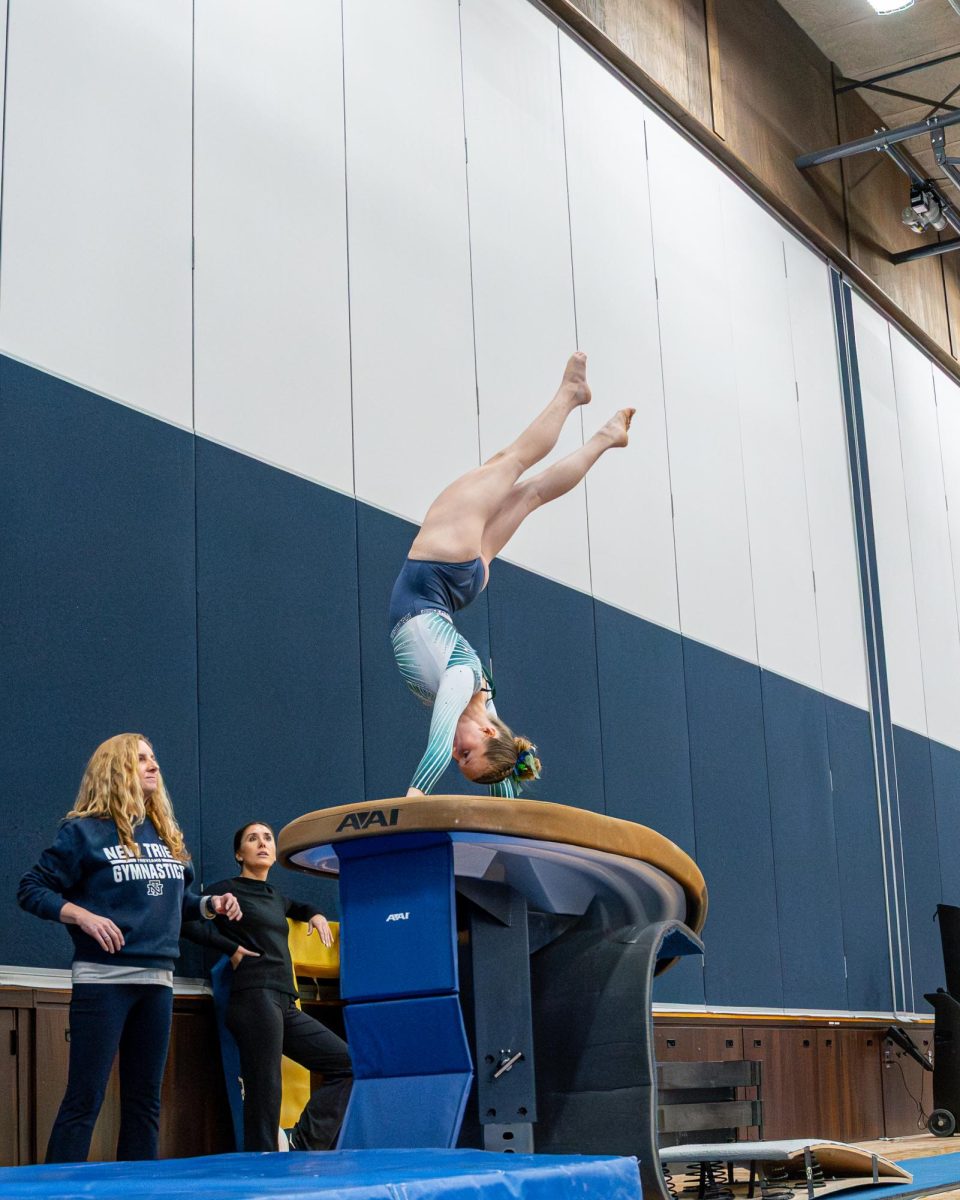
New Trier girls varsity gymnastics started its season strong by defeating Maine East on Dec. 4, followed by another victory against Evanston, scoring a 135.80 on Dec. 9. The highest team score so far was a 136.45 against Glenbrook South on Jan. 13. The team’s hard work is clearly paying off—but what does it take to get there?
Across multiple meets, Harper Jacobs earned a 9.2 on vault and a 34.45 all-around, Anna Virgili scored an 8.9 on uneven bars, Karis Park achieved a 9.4 on floor, and Lucie Friedman and Elena Scarano tied on balance beam with an 8.8. With numerous athletes scoring the highest individually for different events, the season’s success has been a team effort.
Gymnastics isn’t an easy sport. The sport requires long hours, strenuous months, and dedicated years of practice to perform a routine barely exceeding two minutes.
“It doesn’t really come naturally,” head girls gymnastics coach Jennifer Pistorius said. “Some of [the girls] have been doing gymnastics since they were two or three years old.”
Intense physical training takes a toll on a gymnast’s body: most athletes expect several season injuries, an obstacle they’re expected to muscle through. The gymnasts commonly tape their ankles or wrists, preventing strain from the pressure of landing on their feet or their hands.
“Last year, everyone had ankle injuries, and this year, a lot of people have back injuries,” senior captain Anna Virgili said. “People are starting gymnastics at the early age of three or four, and that much strain on your body for 10-plus years really takes a toll.”
On Wednesdays, the team focuses on rehabilitation exercises, concentrating on major injuries that the girls may have.
“[Injuries] are very common,” Pistorius said. “There’s a lot of taping, but we’re very fortunate at New Trier to have one of the most amazing athletic training offices and staff in the country.”
Spending time at the trainer is part of the commitment to gymnastics. Many of the girls go to physical therapy, combatting stress injuries from strain.
“With gymnastics, most injuries aren’t preventable,” senior captain Elena Scarano said. “When you’re flipping, it’s very unpredictable how things might go. Every single time, there’s a risk of a really high injury.”
While practice starts at 3:30 p.m. after school and officially ends at 6:30 p.m., the girls often stay an extra hour for additional strength training. Utilizing the first three hours to train each event–uneven bars, vault, floor, and beam–and the fourth hour for added exercise and conditioning, the gymnasts train vigorously to build endurance and stamina.
“I think a lot of people get really surprised at how physically demanding and intense the training is,” Scarano said. “When we tell people that our practices are four hours, multiple days a week, I think people don’t really see much it takes inside and outside the gym.”
Not only can a mistake or a fall impact the athlete’s self-confidence, but it decreases a gymnast’s score.
“Coming back from a fall is something that you learn throughout your gymnastics career, because you have to figure out what works best for you and what doesn’t,” Scarano said. “You have to navigate what self-talk, breathing techniques, or mechanisms help you best recover from a fall. Growing up, you have to learn that when you fall during a routine, your routine’s not over, and you have to finish strong.”
After spending the majority of their lives in gymnastics, most girls don’t continue the sport in college.
“This is the end of the line for 99% of the girls,” Pistorius said. “In all my years I’ve been here, there have been [only] a handful of girls that have gone on to compete in college, because [colleges] just don’t have the programs.”
Senior gymnasts know that their last year is the final push: it’s an opportunity to finish their gymnastics career strong, and to reflect the leadership, resilience, and skillset they’ve developed over the years.
Gymnastics is arguably one of the most demanding sports for high school athletes. The risks are great, injuries are common, and practice is rigorous—but for the girls, it’s worth it.
“As hard as it is, they really have fun,” Pistorius said. “Every year it’s a great group of girls, and they really get along well. They do work really hard, but they can also have a good time at practice, playing music and dancing.