









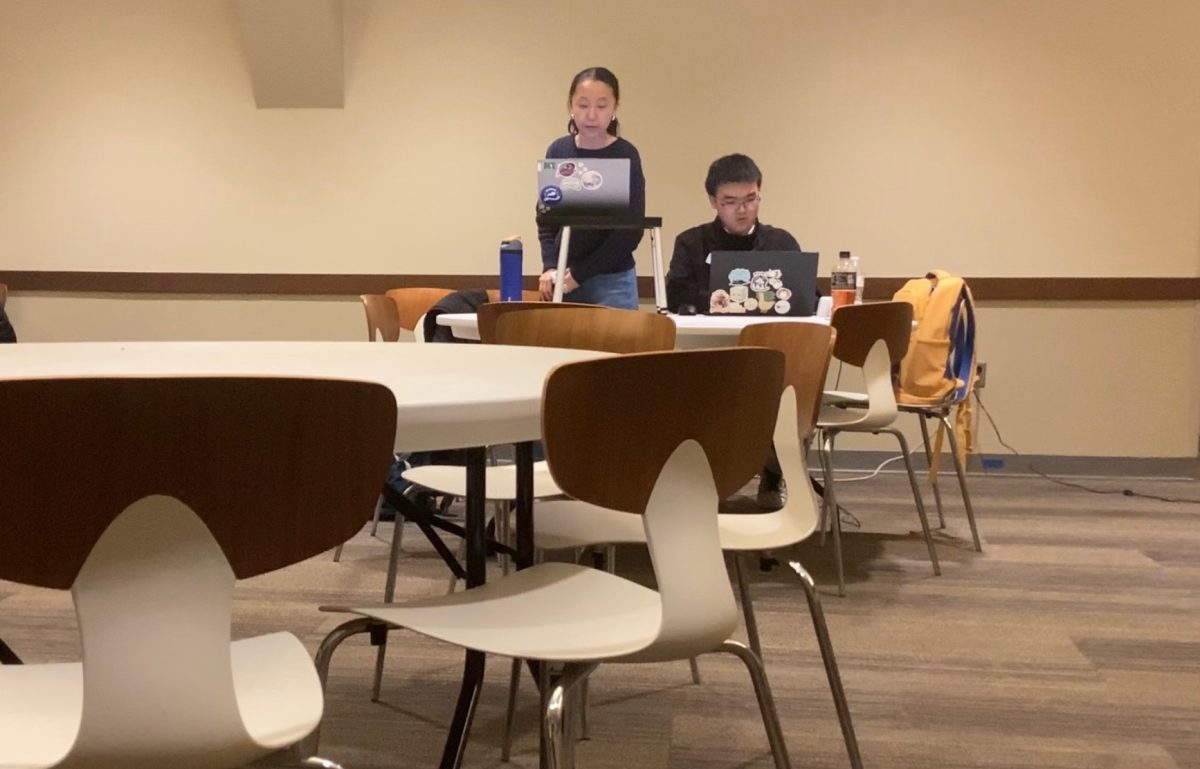
After qualifying for several prestigious debate tournaments, senior Matt Peng and junior Renee Ma are just getting started.
Ever since being selected to work together by Head Speech and Debate Coach Aaron Vinson at the beginning of last school year, the pair has been successful. Due to their strong performances two years ago—the two won the Niles Invitational as well as placing high at tournaments hosted by the University of Michigan, Glenbrook North and Glenbrook South—Vinson knew that the two would work well together.
“There were a lot of accomplishments that they had really early on in their careers that only one or two of our other teams have had in a while,” Vinson says.
These successes were not just the result of their individual skills, but also their teamwork. In policy debate, the specific style practiced by New Trier’s Debate team, the entire organization focuses on one topic for the school year. Each tournament then discusses a specific aspect of the topic, where partners propose a policy to their opponents and debate the positives and negatives of each policy. One person is in charge of the “affirmative” position and policy; the other in charge of the “negative” position, which anticipates the opponent’s policies and finds its weaknesses. Ma is in the affirmative position while Peng is in the negative position.
Despite the segregated nature of preparation, Peng thinks that the two still manage to work together by helping each other create initial arguments, find evidence, and identify potential weaknesses in each other’s arguments.
”We [just] bounce ideas off of each other,” Peng says.
In doing so, the two have come to respect each other for their tireless efforts.
“Matt’s a super hard worker, which I really appreciate,” Ma says. “I think we equally put in a lot of work to do the research and preparation. It’s a very balanced partnership.”
This intense preparation, which often would take up all of their free time, led to the pair to be the only New Trier Debaters to attend several prestigious competitions, such as the Justin Wilson Debates Pace Round Robin on Jan. 25. Located at Pace School in Atlanta, Georgia, the round robin only invites the top seven pairs in the nation.
“New Trier has been invited [to the Justin Wilson Debates Pace Round Robin] before, but only once or twice in the last 15-20 years,” Vinson says.
There, Peng and Ma placed fourth, as well as received distinctions of being the seventh and sixth overall best individual speakers, respectively.
On Jan. 26, the pair continued their success by going to Emory University for another selective invitational: the Barkley Forum for High Schools.
The pair won all six of their preliminary matches and ultimately made it to the semifinals on the invitational—the best New Trier has performed in about 15 years. Peng was ranked the 12th top speaker and Ma 13th.
While their success has raised their confidence, they, regardless, strive for growth and perfection. Yet when combined with the added stress from their junior and senior classes, other extracurriculars, and life in general, these big competitions add a lot of pressure.
“[Being selected for these tournaments has] been good for my confidence—in terms of feeling that I am more recognized [in the debate community], but it’s also a more stressful endeavor because [we] really do want to do well,” Peng says.
However, Ma finds the work fun, making the stress take a backseat to the excitement.
“It’s definitely a struggle managing it,” Ma says. “But the process of preparing for tournaments is fun for me, at least. I usually look forward to doing my debate work.”
In the future, Peng and Ma are looking forward to another equally-selective invitational: the California Round Robin hosted at University of California Berkeley. As Peng and Ma work toward potentially heading to nationals at University of Kentucky during April 11-13, they aim to succeed together, combining their strengths.
“Both of us are very driven to be successful,” Ma says. “We both really like doing the research, which I think is one of our strengths as a partnership.”
Not only does the pair enjoy working together, Peng also finds that it teaches them valuable skills needed later in life.
“Time management and stress management has really been a large part of [debate],” Peng says. “And then, yeah, it does obviously boost your confidence and speaking skills.”
Peng believes that his experience in debate has pushed him to be more open while speaking.
“You can express yourself without being particularly afraid of how others will react,” Peng says.
At the end of the day, to Peng and Ma, debate is worth the stress and hours of preparation. Ma finds that thanks to debate, she has found a close, supportive group of friends that, to her, make the extra work worthwhile.
“I really like the research aspect, I like crafting arguments, and literally debating itself. It’s something I find a lot of joy in,” Ma says. “And having a support system where you feel valued and seen is really important.”