




Editor’s Note: Features Editor Gaia Saraf is a member of Jazz Ensemble 1 but was not involved in the writing or editing of this article.
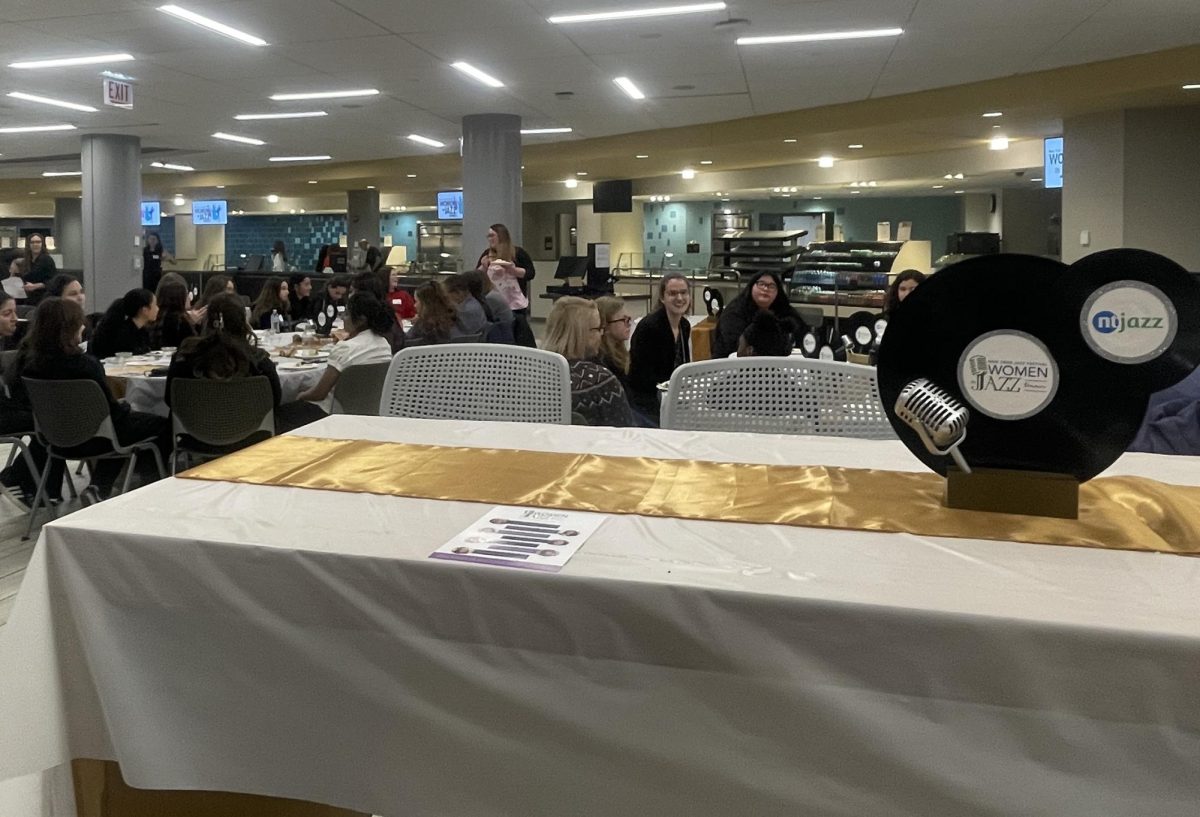
Picture this—a February night safe from the freezing, cold, crisp air outside that turns your nose and cheeks a soft pink. Under the glow of cafeteria lights, tables adorned with plates of marinara-drenched lasagna, stacks of snowy sugar-coated brownies and perfectly ironed pure white tablecloths accented by brassy gold table runners, soft laugher, loud chatter, vibrant live jazz music, and, most importantly, professional female jazz musicians. For some, this may seem like any semi-formal occasion, but at New Trier High School, this is the annual Women in Jazz Dinner.
Created by New Trier Jazz Band Director Nic Meyer in 2018, Women in Jazz Dinner is a space where middle and high school female jazz musicians can connect with female clinicians at Jazz Fest during their shared dinner break from 4:45-6:30 p.m.
“It’s been really important to me to have that representation,” Meyer says. “And over the years, I tried to make [the dinner] a more prominent feature of our festival because sometimes half the people in a band are girls, [and] they’re almost always working with men.”
While the ratio of female to male musicians in New Trier’s Jazz Band fluctuates annually, female jazz musicians do not often have representation in professional jazz, according to Meyer. As a result, Meyer created the dinner to give female jazz musicians an opportunity to see themselves reflected in the professional world.
“I’m a straight white guy so the whole world that I live in is kind of built for me,” Meyer says. “I have my role models that look just like me, but that’s not the case for a lot of our students. And in jazz, which is the subject I teach, there’s almost never women on our stage for the evening concert…And so I feel like I have to do something to convince the young women in my program and in my classes that there’s totally a pathway for you [in professional jazz].”
Every year, the female jazz musicians from any school performing at New Trier Jazz Fest sit down for dinner in New Trier’s cafeteria. There, professional female clinicians play live jazz music for them, and then, the young musicians and the clinicians discuss the challenges and experiences of being a female jazz musician, both in high school and in professional settings.
Historically, the dinner featured a panel discussion between the clinicians and jazz band leaders; however, this year, the jazz musicians gathered in table groups with professional musicians Tanya Darby, Gina Benacázar-López, Aida Brandes-Hargrove, Bethany Pickens, Dr. Crystal Rebone, Marlene Rosenberg, and Maddie Vogler. They discussed topics ranging from music composition to memories about what got them interested in jazz together in a round robin.
For senior pianist Alice Pisarevskaya from Lake Zurich High School, she attended the dinner for the first time this February and left feeling like she found community among musicians from other high schools.
“I felt very seen as a female musician,” Pisarevskaya says. “I’ve never really had these kinds of conversations with people, and I felt very connected with these people, even though I barely know them. It’s like we have a lot of common fears and struggles and aspirations, so I think that it’s a very good dinner in terms of connecting women and making them feel seen in, quite frankly, a very male-dominated field.”
In 2021, females made up approximately 21% of professional jazz musicians according to the nonprofit organization Jazz Empowers. Currently, in Jazz Ensemble 1, female musicians make up two out of the five saxophonists, one out of the four trumpets, three guitarists, and no trombones, pianists, bassists, or drummers. New Trier’s jazz band program is made up of about 20-30% females, according Meyer.
“A lot of times when you picture a jazz musician, I wouldn’t say you picture a girl, unless you think about a singer,” junior and alto saxophonist Maya Zacks says. “So I think having that image of what you can be if you want to pursue music more, it enlightens you to the opportunities that you do have, and you can do this.”
Last year, Zacks and senior Skylar Weinstein were the only females in their Co Lab Jazz Ensemble class which led them to be assigned to create interview questions for the female musician panel. However, this year without the panel discussion, Vogler led the small group discussion event.
“I loved hearing from all different people from all different places,” professional trumpet player Emily Kuhn says. “And it’s cool to hear people’s perspectives and hear what questions people are asking and what people are curious about.”
For Pisarevskaya, her favorite conversation of the night was about a fellow musician’s experience being the only female in her high school’s jazz band.
“One of my classmates was sharing that she was the only girl in her jazz ensemble last year, and while she was friendly with the other guys in her section in a lot of “group-building activities or exercises,” or things that our director wanted us to do, she just couldn’t participate with them because, naturally, the guys were swinging to hang out with the guys,” Pisarevskaya says. “I think the conversations [at the dinner] were very reassuring in the sense of [jazz] is a growing field, there’s more women coming in, and you are seen even in situations where you feel like you’re the only person there.”
According to Meyer, the only challenge to running the dinner is its cost, but he is happy to pay the price regardless because of the positive impact it has had on young female musicians who are part of a minority.
“Our girls are smart,” Meyer says. “They can look around the room and be like, ‘there’s not a lot of girls here, right?’ So they already kind of look to each other. But then to have an event that kind of calls it out and empowers them helps build that sense of ‘hey, we’re a thing.’”
Looking ahead to the 2026-2027 dinner, Zacks is hoping to get more young female musicians to perform at the dinner.
“One of the ideas we have is to get another high school combo who are women to perform [at the dinner],” Zacks says. “Which is what we [did in 2024], and I think we’re gonna try and get that going next year too.”
However, the dinner will continue empowering young female musicians which, besides the free food, is the reason why many young female jazz musicians gather in the New Trier cafeteria during a chilly winter day’s last light in the first place.
“It’s pretty fun to be [at the dinner],” Zacks says. “The group is very supportive and there is that commonality of being a woman in jazz, even though it’s not really something you choose.”