





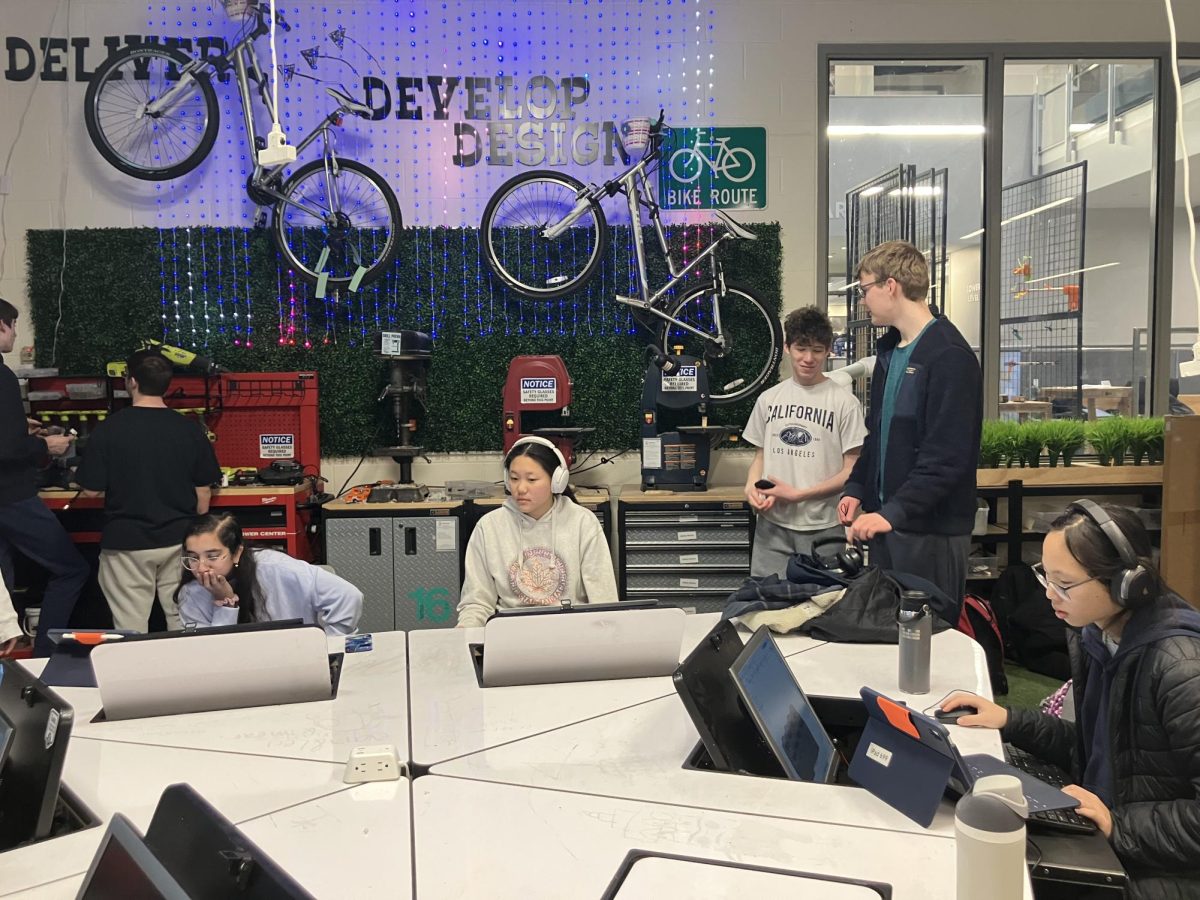
In room W034 on the lowest level of New Trier High School, students craft robots, experiment with drones, and carefully assemble prosthetic limbs. What began as a small, focused robotics club has slowly transformed into a dynamic, student-driven program that spans land, air, water and everything in between.
The robotics club provides opportunities for students to participate in VEX land robotics, remotely operated vehicle (ROV) underwater robotics, drones, as well as the newest addition of ENABLE prosthetics. Each of these groups compete (with the exception of ENABLE, whose members are in the process of advocating to add competitions for their category).
“We’ve grown into a grassroots movement where we race against other high schools and host competitions,” Technology Education Faculty Chip Finck, who is also the head sponsor of the club, says. “Everything that we do is all student led, student run, and they are the ones making all the decisions.”
Each division operates under student leadership, with heads and co-heads organizing projects and teaching newer members. For ENABLE, the prosthetics group, this means working on prosthetics for personal problems.
“We’re currently working on a dog whose front right limb is missing,” head of ENABLE Rayyan Ladhani says. “Oreo was a family friend of the old co-head of ENABLE—we started working on his prosthetic two years back, and we had him in the lab, got his measurements, and tried our best to make a prosthetic that would fit his disability.”
Unlike the competition-oriented divisions, ENABLE’s work is built around service. Members spend meetings 3D printing parts, assembling hands and refining designs in software such as Autodesk Fusion 360. New students typically begin by producing standard prosthetic hands to learn the process before moving onto more complicated designs.
“For the hands, there’s an online community where we can get the 3D models right off of the internet and basically plug it into our printers, and from there we assemble all the parts,” sophomore ENABLE member Maggie Mueller says.
ENABLE’s work is not without its challenges. Technology evolves quickly, and the team must constantly adapt to new tools and techniques. Oreo’s prosthetic, for example, has required multiple iterations over the years. The team has been experimenting with Light Detection and Ranging (LiDAR) 3D scanning, a technology that uses pulsed laser light to create precise digital representations of objects, namely Oreo. According to Finck, the process has a definite learning curve.
“I mean, no one has any real expertise in any of this stuff, we’re all learning as we’re going, and there’s a lot of trial and error,” Finck says. “It’s also just researching to see what’s out there. There are some really cool companies, so we’ve been watching their reels on Instagram and trying to mimic the stuff they do.”
ENABLE’s past projects include prosthetic arms for a man from Nigeria who had both arms amputated in a civil conflict, a 5-year-old boy born with a limb difference, and a man who lost most of his fingers due to an untreated infection from washing dishes. For Finck, helping each of these people, hearing their stories, and seeing the real impact the prosthetics had on their lives was the most fulfilling part, despite the hurdles.
“[The boy’s] dad emailed me and said, ‘Chip, I can’t tell you the difference that [this prosthetic] has made in my son’s outlook on life. He feels like he has this whole engineering team designing something specifically for him, and his confidence is through the roof,’” Finck says. “It’s really, really cool. He thought he was a superhero.”
Beyond the technical skills and hands-on projects, the club thrives on a sense of community that stretches across all four divisions. Students are constantly learning from each other, sharing techniques, and mentoring newcomers.
“We each work on our own projects, but together we all participate in some form of engineering,” Ladhani says. “The community is my favorite part. We’re building relationships with each other and with the patients we help.”
Inclusion is another motivation. Mueller emphasizes her own efforts with the club fair and mentorship to bring in a more diverse group of students, particularly young women, into traditionally male-dominated STEM fields.
“We had four freshmen girls join this year, which is huge—it’s one of my big initiatives to bring more girls in,” Mueller says. “I try to be an advocate that girls can do it too, and I want to introduce [the club] as an activity where you don’t need any prior experience, because you really don’t.”
The club’s achievements are supported by New Trier’s exceptional resources. With dedicated engineering rooms, advanced 3D printers and a variety of specialized tools, students can push the boundaries of what a high school robotics program can accomplish.
“We have access to almost any tool under the sun, and to be able to always ask for more is amazing,” Mueller says. “There are very specific parts that go into building a prosthetic for a dog, so it’s crazy that we can even get those materials.”
Leadership within the club is determined by capability and initiative rather than age or grade.
“It’s like, low floor, high ceiling,” Finck says. “Anyone can join, and you can take it as far as you want. The club leaders are leaders because they want to lead, and they are the ones in the driver’s seat.”
Many students in turn feel ownership over their work and the direction of the club. Mueller reflects on how the club’s influence extends not just to the patients, but also to the team itself.
“This club has opened a pathway for me in college that I did not expect,” Mueller says. Before robotics and my biotechnical engineering class, I definitely wanted to go into biology, but I found that I really like engineering and the working with my hands aspect, and I think that being in this club has expanded my knowledge of what opportunities are out there, because now see what I really want to do.”
Finck echoes this sentiment of opportunity, noting how New Trier’s abundance of electives and extracurricular activities can help students discover and pursue their passions, which might even lead to a future career.
“My hope and desire for every student is that they are going to find what their passion is before they leave New Trier,” Finck says. “There’s so many great opportunities to discover, that it’s a shame to not take advantage of them.”